Русский
 English
 ქართული
 Français
 Türkçe
 Հայերեն
 Қазақша
 Polski
 Azərbaycanca
 O'zbekcha
 中文
 Deutsch
 Español
 العربية
 فارسی
 हिन्दी
 עברית
 Vacation 13 min read
Summer Hiking in Georgia: Trails, Routes and Season
 GustawsonEditorial Team · Bebgur
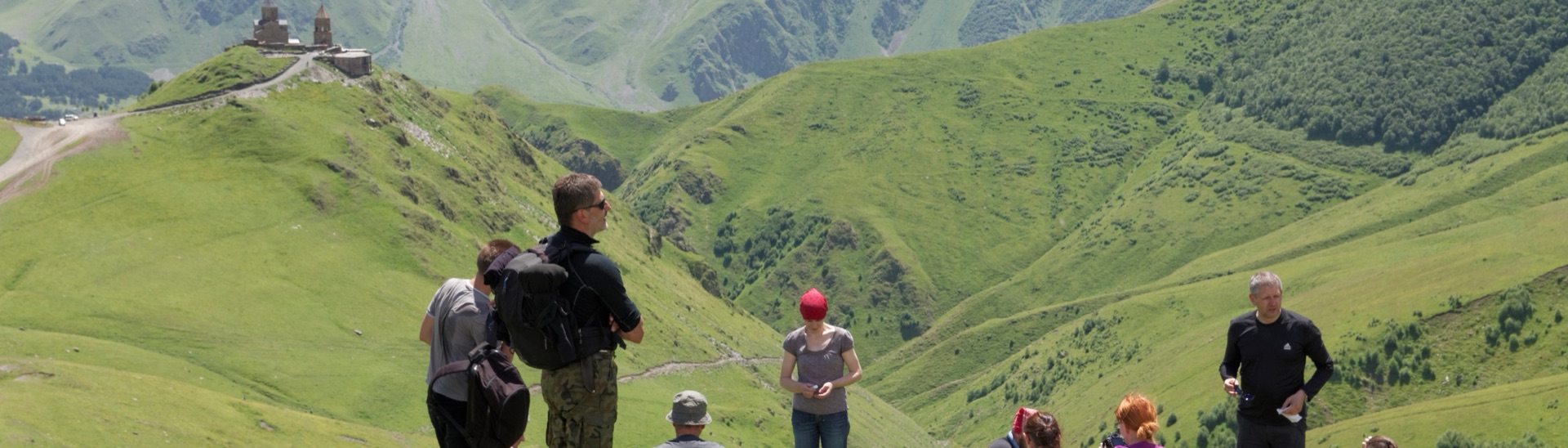
Summer hiking in Georgia takes very little preparation: you can walk for half a day up to the church that overlooks Stepantsminda, or spend four days going from village to village across Svaneti. Most trails need no climbing gear, and you can sleep in family guesthouses where the hosts serve dinner and breakfast.
The regions hikers choose most often are Kazbegi, Svaneti, Tusheti, Lagodekhi and Borjomi. Many trails begin right in a village you can reach by marshrutka, the shared minibus, and the most remote villages are a 4x4 ride away.
When to Hike in Georgia
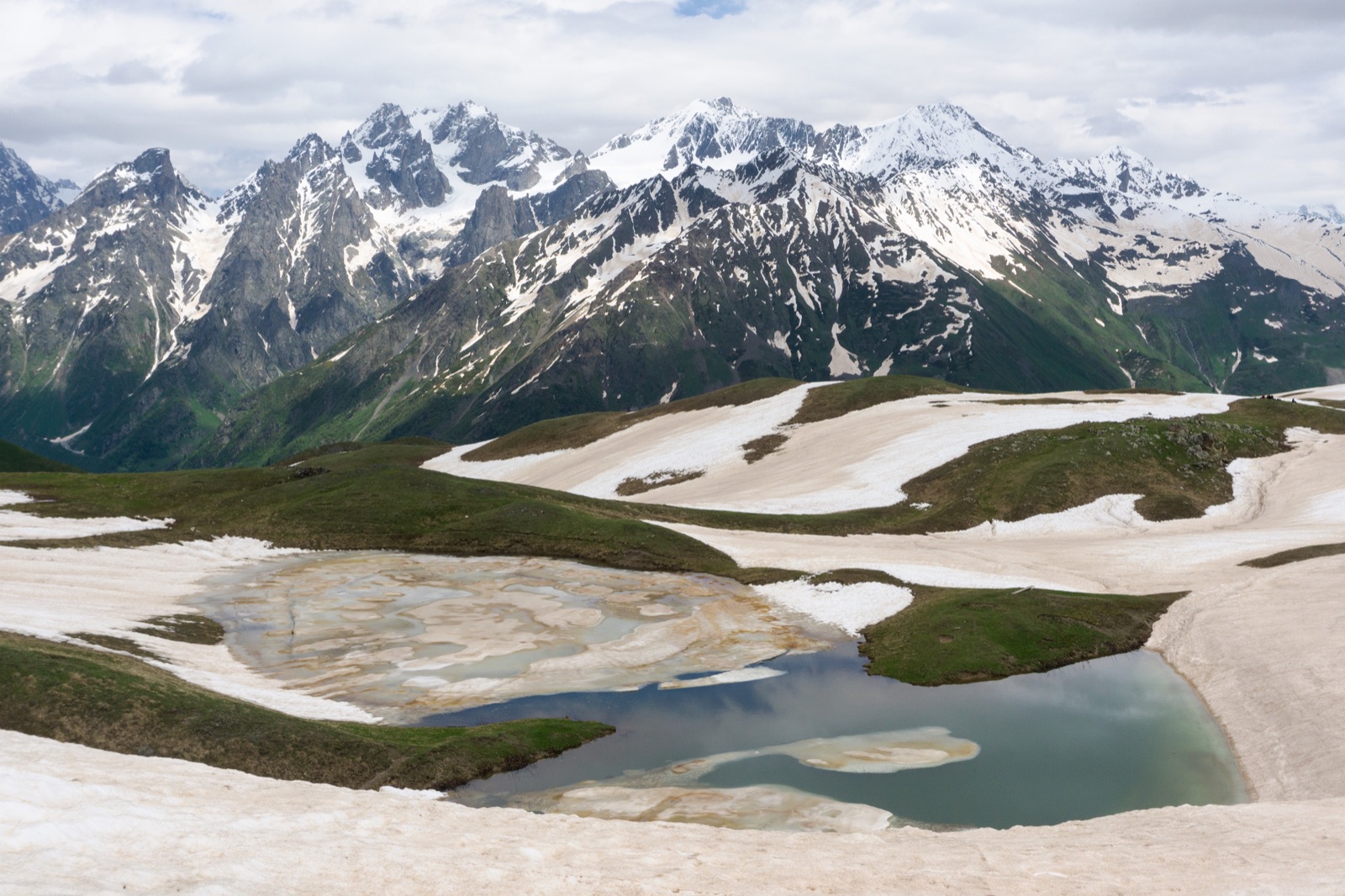
The main season in the high mountains runs from June through September. On passes higher than 3,000 m the snow often lingers into July, so the highest routes, such as the crossings of the Chaukhi and Atsunta passes, open in late June or in July.
The forest trails of Lagodekhi and Borjomi are walkable from roughly April to November. In summer the climate in the mountains of Georgia is mild. In July, Stepantsminda sees about 20 °C by day and around 8 °C at night, so you need a warm jacket even in August.
Mid-September is considered the best time for the Mestia-Ushguli trek, and the reason becomes clear when you compare Georgia month by month. In August this trail sees up to 150 hikers a day, while in September the crowds thin out and the weather is usually settled.
October still works for hiking, but the choice of routes is smaller. The Mestia-Ushguli trail stays walkable until the end of the month, and the forests of Lagodekhi and Borjomi turn gold. From the second half of October heavy snow falls in the high mountains and the passes close.
The road into Tusheti over the Abano Pass usually opens to 4x4 vehicles in June. In 2026 it opened on June 20, and in 2025 it was already open on May 25. In the fall it closes because of snow.
In 2026 the road was first shut on October 4, but four days later 4x4s were let through again. Before you set out, check the current state of the mountain roads in Georgia; the live status there covers both Tusheti and Shatili.
Routes: From a Half-Day Walk to a Week-Long Trek
For multi-day treks the table gives the full length of the route, and for day hikes it gives the round-trip distance.
| Route | Region | Distance and time | Difficulty | Season | Getting there |
|---|---|---|---|---|---|
| Stepantsminda to Gergeti Trinity Church | Kazbegi | 6 km, 3-4 hours | easy | year-round, easier in summer | marshrutka from Tbilisi |
| Gergeti Glacier | Kazbegi | 20 km, 8-10 hours | hard | July-September | marshrutka from Tbilisi |
| Truso Valley | Kazbegi | 22 km, 6 hours | moderate | May-October | taxi from Stepantsminda |
| Juta, the lake under Chaukhi | Kazbegi | 8-13 km, 5-6 hours | moderate | June-October | taxi or transfer from Stepantsminda |
| Juta to Roshka over the Chaukhi Pass | Kazbegi and Khevsureti | 18 km, 1-2 days | moderately hard | July-September | taxi from Stepantsminda |
| Mestia to Ushguli | Svaneti | 57 km, 4 days | moderate | June-October | marshrutka or flight to Mestia |
| Koruldi Lakes | Svaneti | 21 km, about 7 hours | moderately hard | July-September | on foot or by taxi from Mestia |
| Chalaadi Glacier | Svaneti | 2-3 hours from the bridge | easy | June-October | taxi from Mestia |
| Omalo to Diklo | Tusheti | 11 km, 4 hours | easy | June-September | 4x4 from Alvani |
| Omalo to Shatili | Tusheti and Khevsureti | 75 km, 4-5 days | moderate, with a high pass | July-August | 4x4 to Omalo |
| Ninoskhevi Waterfall | Lagodekhi | 8.5 km, 4-6 hours | moderate | April-November | car or marshrutka to Lagodekhi |
| Black Lake | Lagodekhi | 48 km, 3 days | moderate | June-October | car or marshrutka to Lagodekhi |
| Likani Valley | Borjomi | 7 km, 4 hours | moderate | April-November | marshrutka from Tbilisi |
Kazbegi: Gergeti, Truso and Juta
The easiest place to start is Stepantsminda (Kazbegi), which sits at 1,740 m. The marshrutka from Tbilisi takes 3-3.5 hours to get there. The climb to Gergeti Trinity Church is short, about 500 m of elevation gain, and even children manage it.
The route to the Gergeti Glacier under Mount Kazbek passes the same church and crosses the Sabertse Pass at 2,900 m, with about 1,550 m of gain, so hikers start early in the morning. Only experienced people cross the glacier itself to the weather station, and ideally they do it with a guide.
The Truso Valley suits anyone who dislikes steep climbs: a dirt road runs along the river from the village of Kvemo Okrokana to Zakagori Fortress, past mineral springs, travertine terraces and the turquoise Abano Lake. A border checkpoint stands at the fortress, and nobody goes farther without a permit. A taxi from Stepantsminda drops you at the start of the valley and waits, usually for 80-100 lari per car.
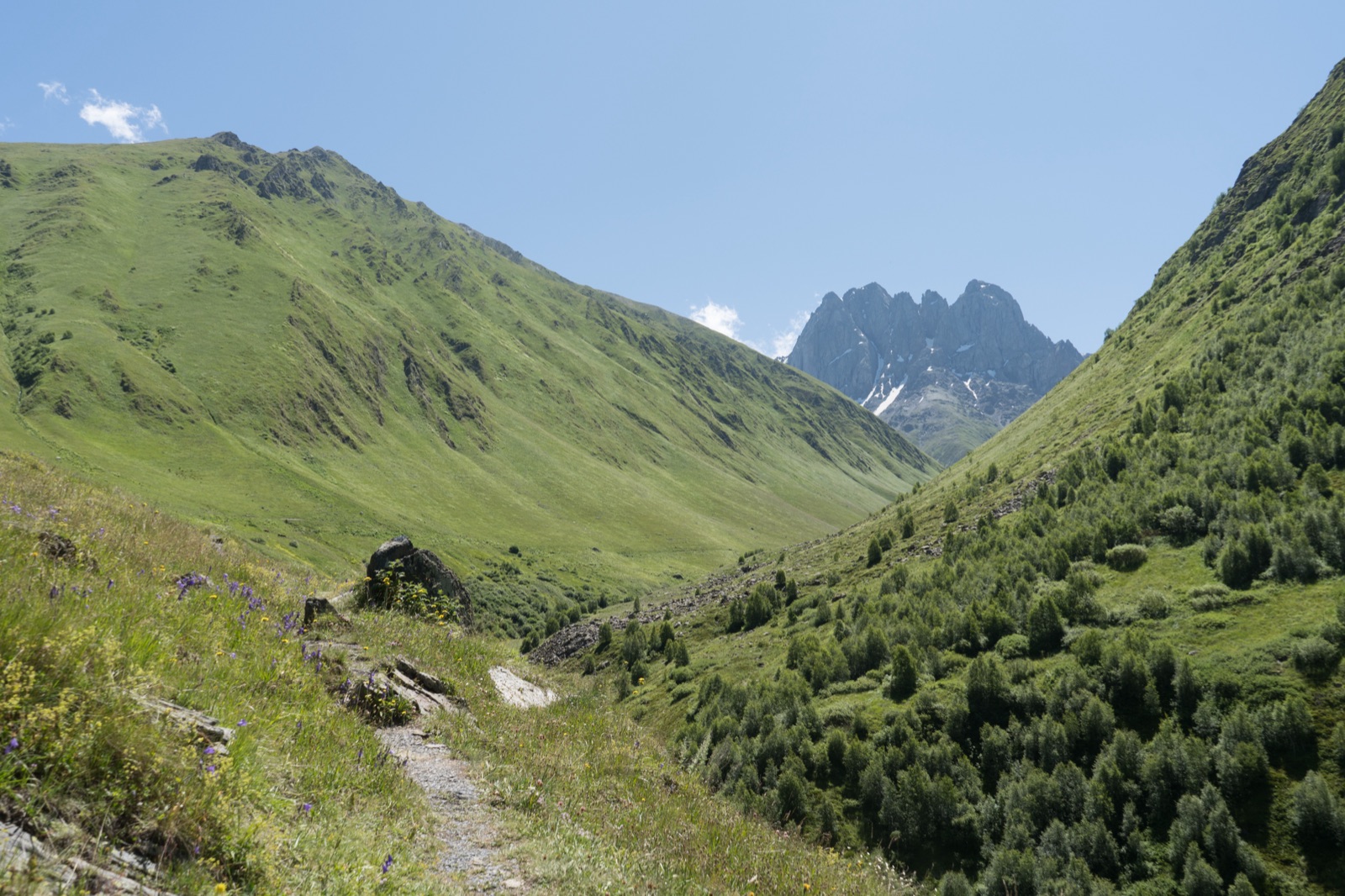
The village of Juta sits at 2,200 m under the Chaukhi massif, which people call the Georgian Dolomites. The last 2.6 km of the road to the village are closed to cars, so from the barrier you walk about 40 minutes, and a taxi from Stepantsminda to Juta costs from 60 lari one way.
Fit hikers continue over the Chaukhi Pass at 3,341 m to the three Abudelauri Lakes and descend to the village of Roshka in Khevsureti. Snow usually lies on the pass until July.
Svaneti: Mestia-Ushguli, Koruldi and Chalaadi
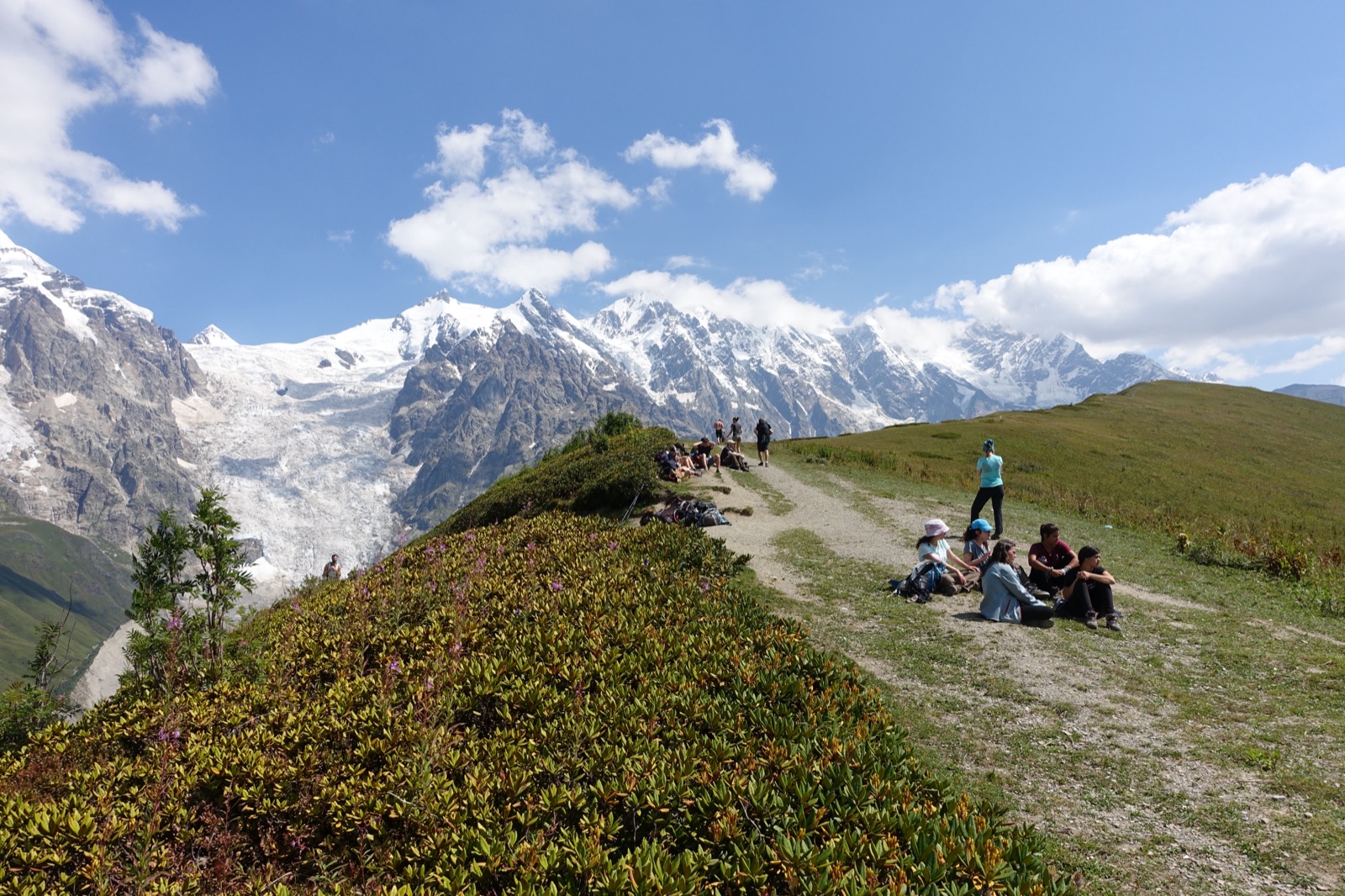
The Mestia-Ushguli trek is considered the most popular multi-day route in Georgia, with overnight stops in the villages of Zhabeshi, Adishi and Iprali. The first and last days are easy, while the second and third each climb almost 900 m. The highest point of the route is the Chkhunderi Pass at 2,655 m.
You need no tent, because every village has guesthouses that serve dinner and breakfast, though in July and August they get booked up in advance. Past Adishi a river crosses the trail; hikers ford it in the morning while the water is lower, and in season locals carry people across on horseback for 20-25 lari per person.
From Mestia you can hike to the Koruldi Lakes at about 2,740 m, but the climb is steep, almost 1,460 m, so many people take a taxi for the first stretch up to the viewpoint with the cross. For the Chalaadi Glacier a taxi takes you to the suspension bridge, and from there the walk is almost flat.
You can also walk to the glacier straight from Mestia, but that stretch is not the most pleasant one: a hydropower plant is being built in the valley, and trucks use the road.
Tusheti and Khevsureti: Omalo and the Trek to Shatili
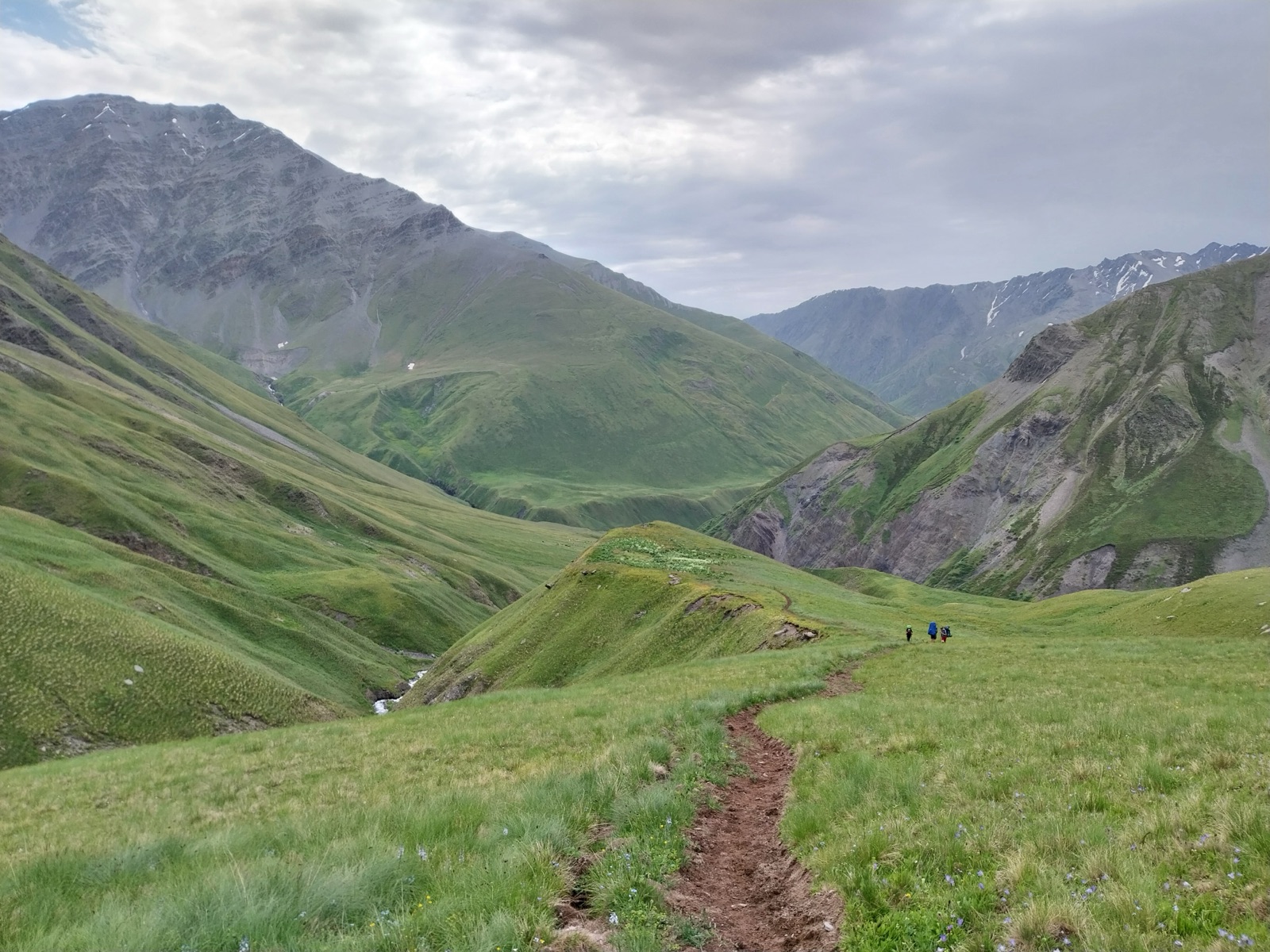
Tusheti can only be reached by 4x4 over the Abano Pass, and the road is closed for most of the year. The village of Omalo serves as the main base for hiking, and Tusheti National Park offers 11 marked routes of 1-6 days.
For a first day, the walk from Omalo through Shenako to Diklo works well, and you can come back by car. Flocks with aggressive sheepdogs graze on the slopes near Shenako, so hikers give the herds a wide berth.
The hardest part of the trek to Shatili is the climb over the Atsunta Pass, which is higher than 3,400 m. The border guards let hikers onto the pass only once the snow has melted, and in 2025 and 2026 the trail opened only in July.
The route runs along the border with Russia, and everyone registers at the border post in the village of Girevi, which takes about an hour. You show the permit at the following posts all the way to the Mutso fortress before Shatili. If you are going in early summer, call the Tusheti National Park administration at 577 10 18 92.
Lagodekhi: Waterfalls and the Black Lake
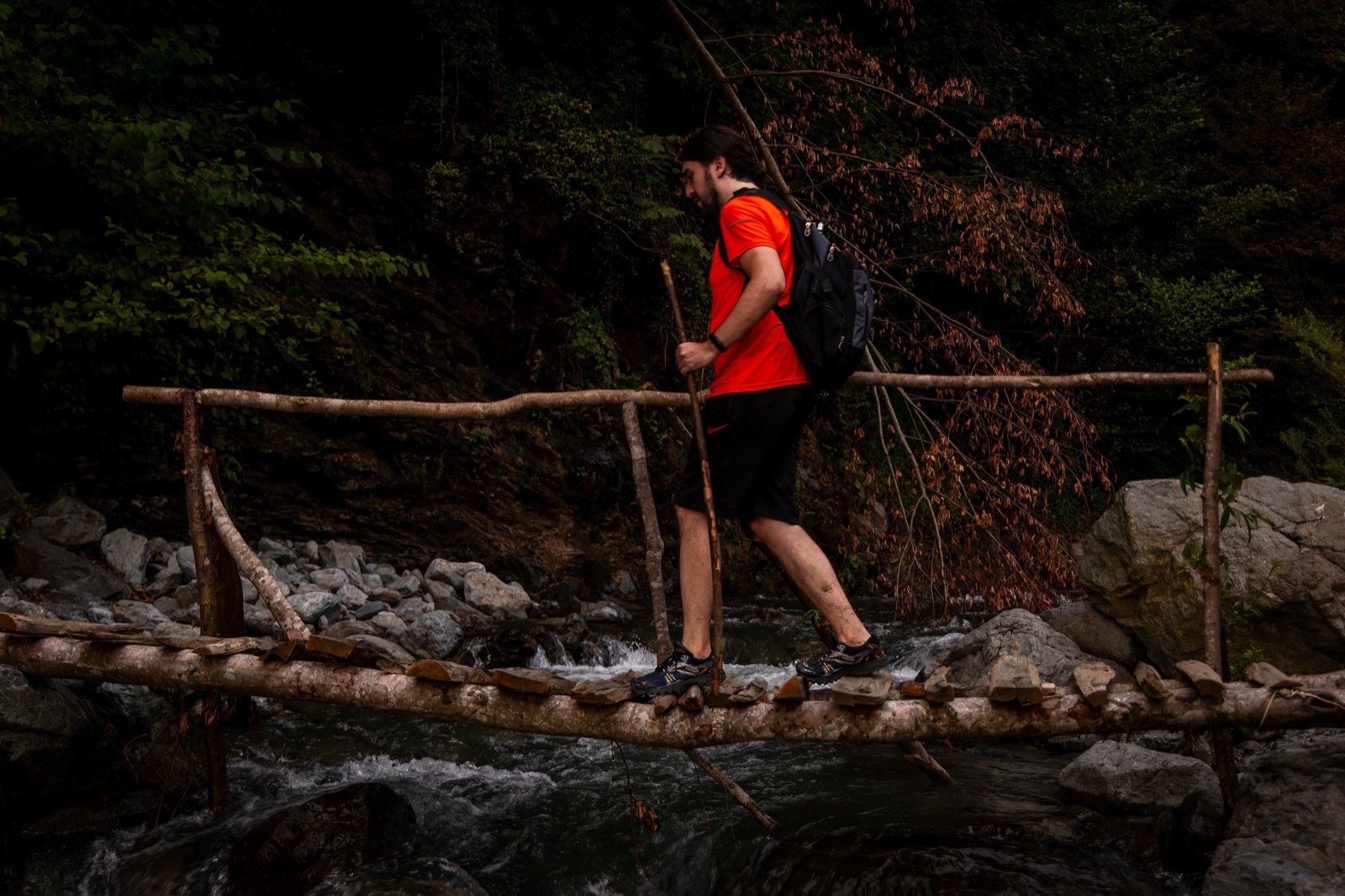
The Lagodekhi reserve in the east of Kakheti was founded in 1912 and counts as the oldest in Georgia. Dense forest takes the place of alpine meadows here, and the trails are open almost all year.
The most popular day hike leads to the Ninoskhevi Waterfall, which is about 40 m high. Before setting out, everyone registers at the reserve's visitor center in Lagodekhi at 197 Vashlovani Street, and the three-day route to the Black Lake, with nights in a 16-bed shelter, also requires a copy of your passport.
Borjomi-Kharagauli: Trails From the Resort
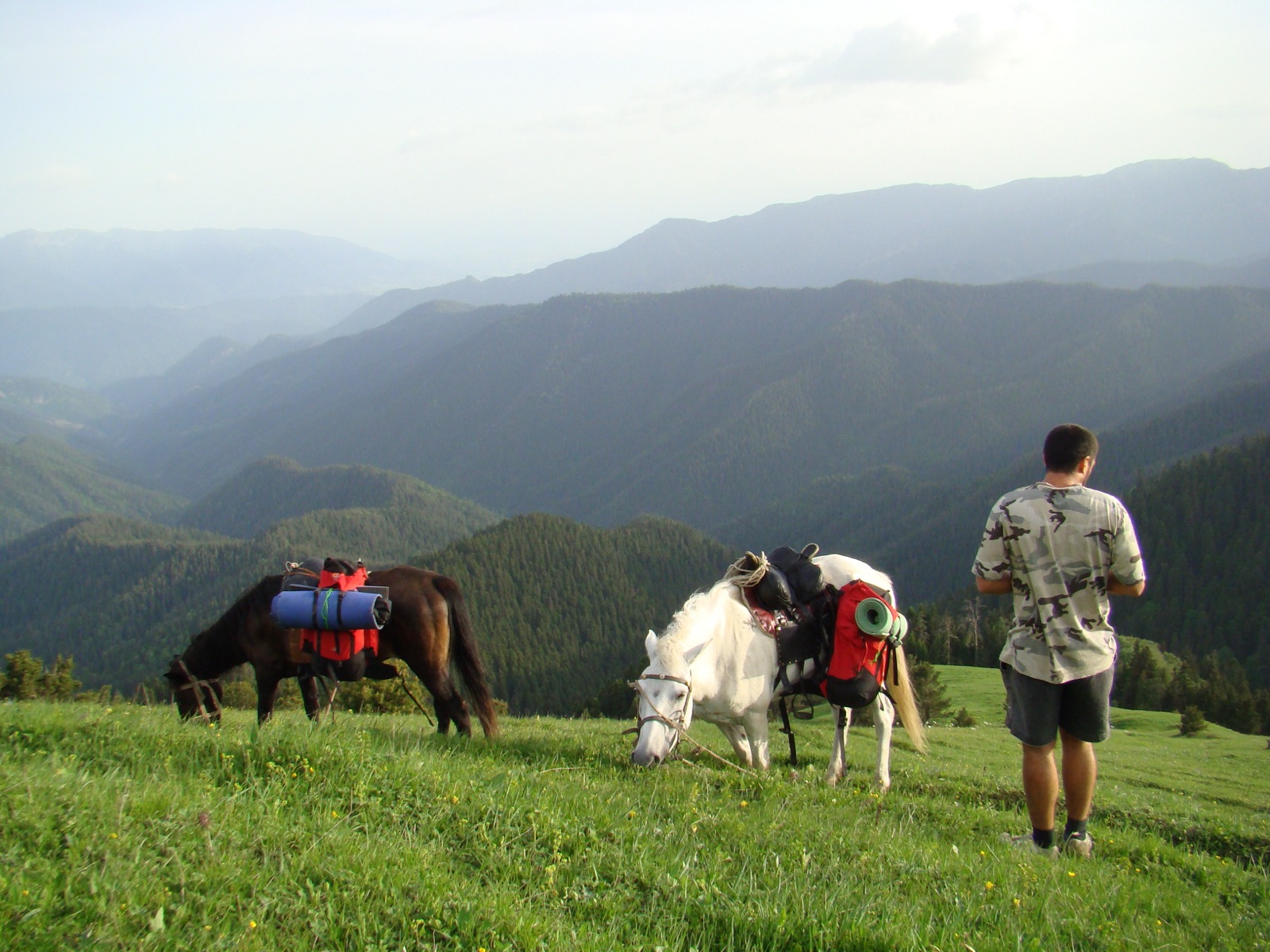
Borjomi-Kharagauli National Park begins right in the resort town of Borjomi, 2-2.5 hours from Tbilisi by marshrutka. The park has 12 marked trails, and before any of them you register at the park's visitor center in Borjomi at 23 Meskheti Street. It is open on weekdays from 9:00 to 18:00 and on weekends until 16:00.
Good first choices are the 3 km information trail from the visitor center or the loop through the Likani Valley. Trail No. 6 runs from Likani to the Kvabiskhevi shelter, 13 km and about 6 hours, and for an overnight trek there is the 43 km Nikolay Romanov Trail, which takes 3 days.
Routes on the Map
The cards with a car icon show the drive from Tbilisi, Kutaisi or Zugdidi to the trailhead, and the cards with a walker show the trail itself. The map does not plot marshrutkas or 4x4s with a driver.
By car to the trailhead
On foot along the trail
Tap a route to open it on the Bebgur map. The map calculates walking time as if the ground were flat, and a climb takes longer. On a gentle climb allow roughly twice the time the map shows, and on a steep one allow three times as much. From Gergeti Trinity Church to the glacier, for example, the map shows about 1 h 10 min, while the climb actually takes 3.5-4 hours.
Day Hikes From Tbilisi
If you live in Tbilisi, you can get into the mountains for a single day. The suburban trails start closest to the city. The trail from Kojori to Kiketi, for example, is about 7 km with hardly any climbing, and a bus from the center reaches Kojori in 30 minutes.
The hike along the Saguramo Ridge in Tbilisi National Park is harder: it is 11 km round trip and 4-5 hours on the trail. No public transport goes there, so people drive or take a taxi for roughly 30-40 lari.
Stepantsminda, Borjomi and Lagodekhi are each about two and a half hours from Tbilisi by car, so in one day you can climb to Gergeti Trinity Church, walk part of the Truso Valley, reach the Ninoskhevi Waterfall or loop through the Likani Valley and be back by evening. By marshrutka the trip to Kazbegi takes 3-3.5 hours each way, so in a single day you only have time to climb to Gergeti Trinity Church and return to Tbilisi.
Getting to the Trailheads
Marshrutkas to Kazbegi and Borjomi leave from Didube bus station. A ticket to Stepantsminda costs 20 lari, and a ticket to Borjomi costs 15 lari. Almost all intercity marshrutkas in Georgia work the same way: you pay in cash, and it is best to arrive half an hour before departure.
The fastest way to Mestia is to fly from Natakhtari airfield near Tbilisi. A ticket costs 90 lari and the flight takes about 40 minutes, but seats are scarce and flights are canceled in bad weather. Overland, people take the train to Zugdidi and a marshrutka from there for 30-40 lari, and a direct marshrutka leaves Kutaisi for Mestia in the morning for 40 lari.
No marshrutkas run to Tusheti, so first you need to reach Kvemo Alvani in Kakheti. A marshrutka from Ortachala bus station costs 15 lari and takes about two and a half hours. From there the ride to Omalo in a shared 4x4 takes about 4 hours; a seat costs 100-120 lari, and the whole vehicle costs 500-650 lari.
Driving your own car into the mountains is convenient, but car rental contracts in Georgia usually ban Tusheti, Shatili, Truso and Juta, even in a 4x4. In Tusheti many people hire a local driver even when they have their own car, because the road is narrow, unpaved and edged by a drop-off the whole way up to the pass.
A marshrutka to Shatili runs from Didube once or twice a week, so after the trek from Tusheti it is best to book a seat on the return trip through your guesthouse host.
Lodging, Guides, Horses and Prices
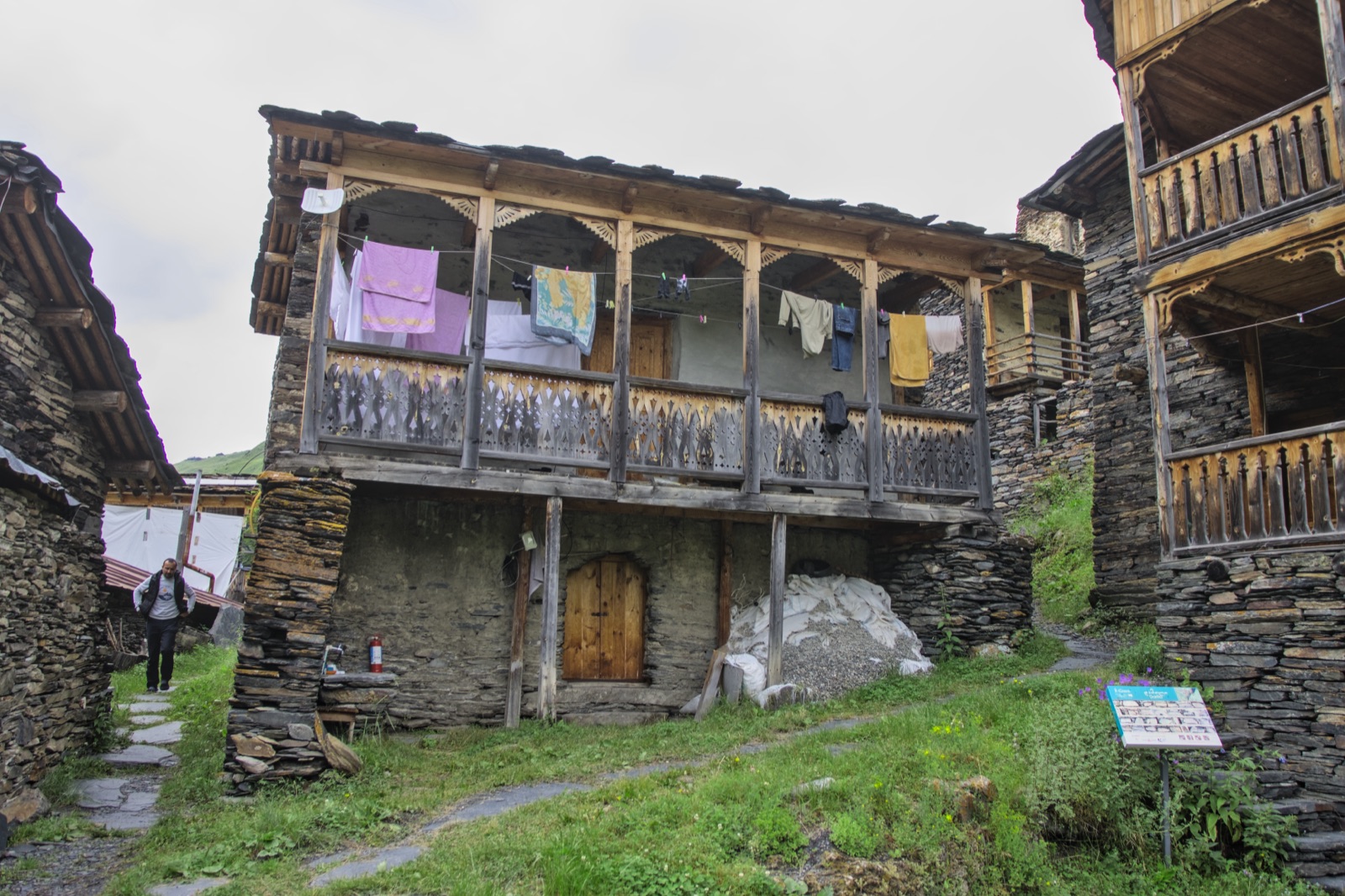
In the mountains people mostly stay in family guesthouses. In August 2026 a guesthouse room in Georgia cost 134 lari a night on average, and in Tusheti a night with dinner and breakfast runs about 100-120 lari per person.
The whole Mestia-Ushguli trek, with three nights on half board, the river crossing and a taxi back to Mestia, comes to roughly 450 lari if you choose inexpensive guesthouses. Tusheti and Khevsureti have no ATMs, and the villages rarely take cards, so bring cash with a margin.
In the Lagodekhi, Borjomi-Kharagauli and Tusheti national parks you pay for services rather than for access to the trails. Under the rates set by the Agency of Protected Areas of Georgia:
- A campsite spot costs 5 lari per person
- A night in a shelter costs from 10 lari in Tusheti to 30 lari in Lagodekhi and Borjomi
- Tent rental costs 10-20 lari a day
- A horse in Lagodekhi costs 70 lari, or 100 lari for a climb into the mountains
You do not need a guide on the popular routes, because the trails to Ushguli, to the Gergeti Glacier and around Juta are well trodden and marked. A guide or a horse handler can be found through your guesthouse host or the park visitor center, and a horse with a handler in Tusheti costs about 200 lari a day.
Safety: Dogs, Bears, Weather and Border Guards
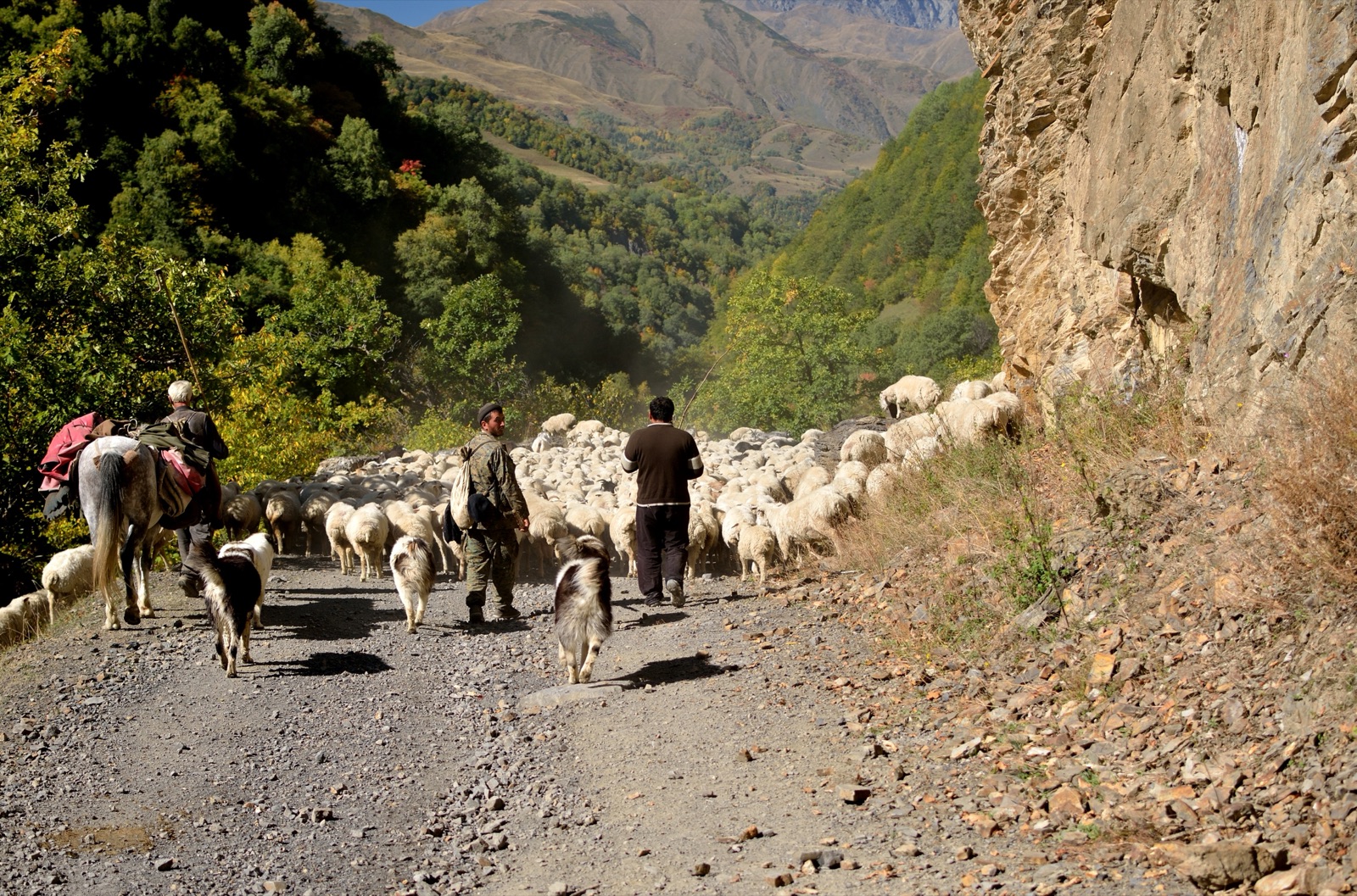
Safety in Georgia is good overall, and the popular trails are calm too: in season they carry plenty of people, and the Mestia-Ushguli route has cell coverage for most of the way. The main risks in the mountains come from the weather, the rivers and the sheepdogs.
Sheepdogs guard the flocks from wolves and bears, and they do not immediately tell a hiker from a predator. If a dog runs at you, stop, do not run, and wait for the shepherd to call it off; a loud voice and trekking poles help keep it at a distance. Rabies exists in Georgia, with 5 confirmed cases in 2025, so after any bite people go to a clinic for shots the same day.
There are bears in the mountains, but they avoid people. Their tracks turn up on the trails, yet actual encounters are rare. On popular routes such as Mestia-Ushguli or Omalo-Shatili the chance of meeting a bear is close to zero, and at a campsite nobody leaves food outside overnight.
Mountain weather changes within an hour, and thunderstorms with hail can be very violent. Start early so you cross the pass before midday, and turn back if the sky darkens. Rivers fed by melting glaciers rise toward evening, so crossings are made in the morning.
After heavy rain the mountains produce mudslides, and for hikers this is the main natural hazard. In August 2023 a mudslide in the resort village of Shovi took 33 lives. If the forecast calls for downpours, it is wiser to pick a forest route or take a rest day.
Cell signal often disappears in the gorges, so download an offline map before you leave and tell your guesthouse host where you are going and when you expect to be back. Only the park visitor centers and the border guards register hikers, so you have to let someone know your route yourself.
If you are injured or lost, call 112. The number is free and works even without a SIM card. The free 112Georgia app sends your coordinates the moment you call, switches to SMS when there is no mobile data, and has a chat with an operator and an SOS button.
Some routes pass through the border zone, and those require a permit. In the Truso Valley it is issued against your passport at the post by Zakagori Fortress, and in Tusheti you register at the post in Girevi. For other places near the border you send an application with your route and passport copies to the Border Police of Georgia at bpol@mia.gov.ge or file it at the office at 12 Kandelaki Street in Tbilisi.
Before a hike, check that your travel insurance for Georgia covers trekking and mountain evacuation. The entry policy with 30,000 lari of coverage is built around the legal minimum, and the limits inside it are modest.
For Beginners and Families With Children
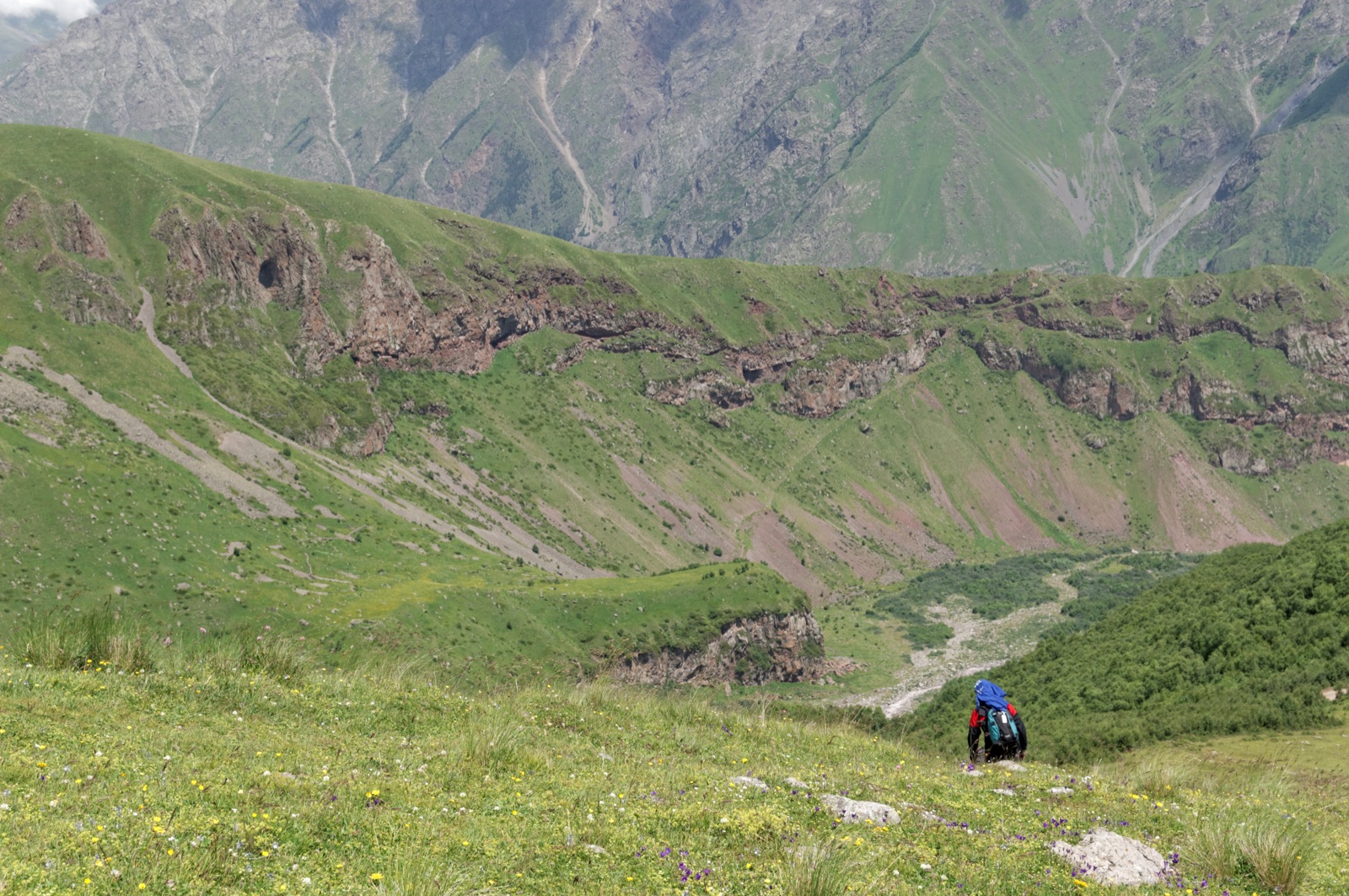
For a first hike in Georgia, routes with no high passes and no nights in a tent are all you need:
- Gergeti Trinity Church from Stepantsminda is 6 km and 3-4 hours, and children manage it
- The Chalaadi Glacier from the suspension bridge takes 2-3 hours with almost no climbing
- The information trail in Borjomi runs 3 km from the visitor center
- Kojori to Kiketi outside Tbilisi is 7 km, mostly downhill
- Omalo to Diklo in Tusheti is 11 km without steep climbs
With children it is better to choose routes you can turn back on at any point. A road also leads up to Gergeti Trinity Church, and a gentle dirt road runs through the Truso Valley, so you do not have to go all the way: with kids you can walk part of it and come back. The Mestia-Ushguli trek is within reach of sturdy teenagers, since a bed and a hot dinner wait for them every evening.
What to Pack
- Wear trekking boots with a stiff sole, because sneakers slip on scree
- Pack a waterproof jacket and a warm fleece, since at 3,000 m it is cold even in August
- Trekking poles help on steep descents and keep dogs at a distance
- Carry 1.5-2 liters of water per person, because there are no springs on the passes
- Bring high-SPF sunscreen, sunglasses and a hat
- A first-aid kit needs blister patches and painkillers
- Bring cash in lari, because the villages rarely take cards
- Download an offline map and pack a power bank
In Short
- The season runs June through September in the high mountains and April through November in the forests of Lagodekhi and Borjomi
- The most popular trek is Mestia-Ushguli, 4 days from village to village
- Day hikes include Gergeti Trinity Church, Truso, Juta and the Ninoskhevi Waterfall
- You need your passport for the border zone and for registration in the national parks
- The emergency number is 112; the call is free and works without a SIM card
Frequently Asked Questions
The main season in the high mountains runs from June through September, and the highest passes, such as Chaukhi and Atsunta, open in late June or in July. Mid-September is considered the best time for the Mestia-Ushguli trek, while the forest trails of Lagodekhi and Borjomi are walkable from roughly April to November.
Yes, but the choice is smaller. The Mestia-Ushguli trail stays walkable until the end of October, and Lagodekhi and Borjomi offer beautiful fall forest at that time. From the second half of October snow falls in the high mountains, and the road into Tusheti closes for the winter.
Not on the popular routes: the trails to Ushguli, to the Gergeti Glacier and around Juta are well trodden and marked. A guide is needed for crossing a glacier, for summit climbs and for little-known trails, and you can find one through your guesthouse host or the national park visitor center.
Not for most routes. In the Lagodekhi and Borjomi-Kharagauli national parks you register at the visitor center before setting out. The border zone requires a permit: in the Truso Valley it is issued at the post by Zakagori Fortress, on the Omalo-Shatili trek you register in Girevi, and for other places you apply to the Border Police.
Bears avoid people, and encounters on the popular trails are rare. Trouble more often comes from the sheepdogs guarding the flocks: stop, do not run, and wait for the shepherd. After any bite you need a rabies shot the same day.
Good options are the walk from Stepantsminda to Gergeti Trinity Church (6 km, 3-4 hours), the Chalaadi Glacier from the suspension bridge, the trails by the visitor center in Borjomi and the Kojori-Kiketi route outside Tbilisi. The multi-day Mestia-Ushguli trek is within reach of sturdy teenagers, since the nights are spent in guesthouses.
With inexpensive guesthouses it comes to about 450 lari per person: three nights with dinner and breakfast, the river crossing on horseback for 20-25 lari, and a taxi from Ushguli back to Mestia. Getting to Mestia is paid separately, and the flight from Natakhtari costs 90 lari.
Only by 4x4 over the Abano Pass, and the road is open roughly from June to October. From Tbilisi you take a marshrutka from Ortachala bus station to Kvemo Alvani for 15 lari, and from there a shared 4x4 to Omalo costs 100-120 lari per person and takes about 4 hours.